
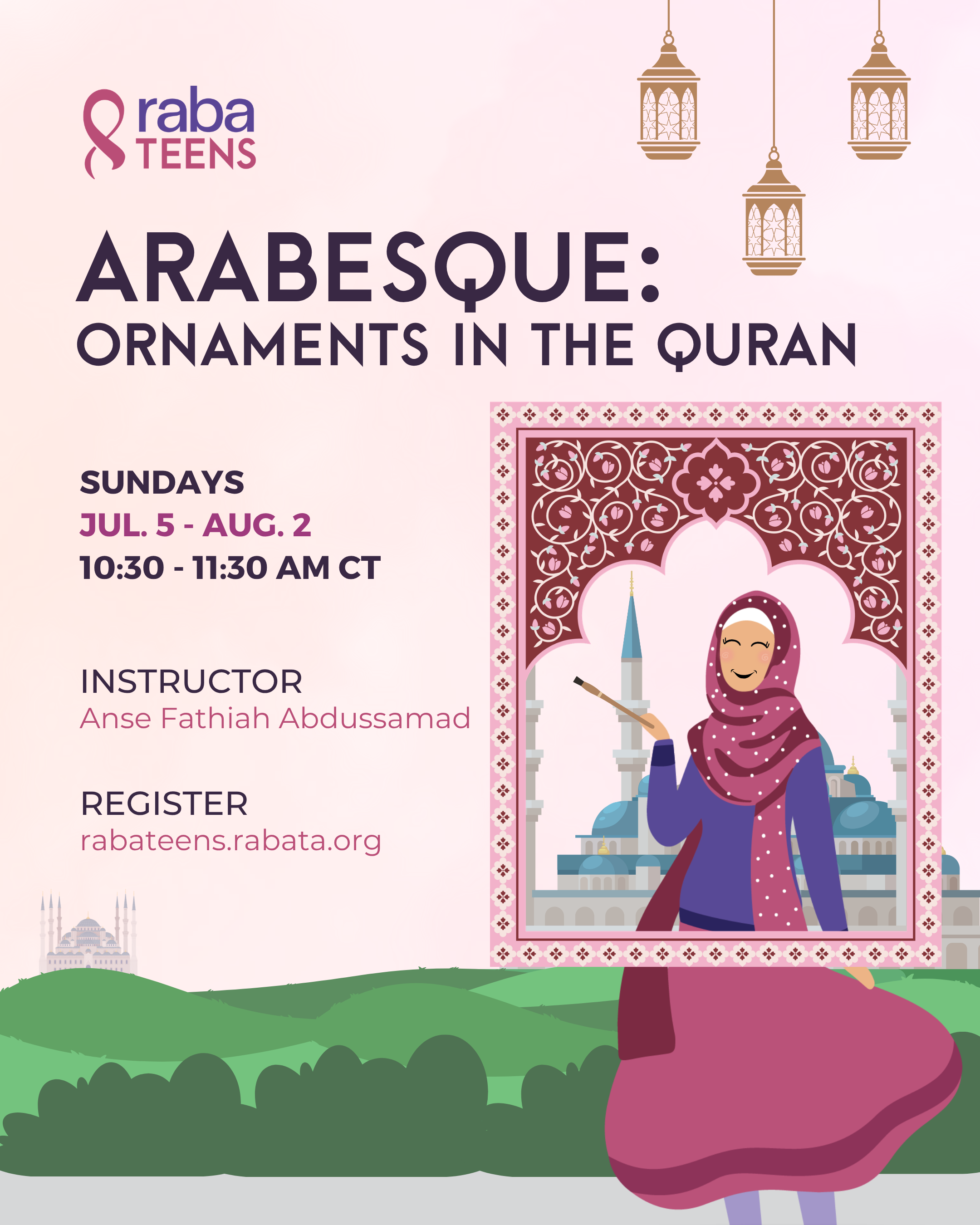
Arabesque: Ornaments in the Quran
Summer 2026
RabaTEENS is a nurturing space for deep and meaningful Islamic spiritual mentorship with compassionate and caring mentors. We design fun, creative, and positive educational experiences to help teens grow confidently and comfortably into their faith.
Islamic art has long been a beautiful form of learning and spiritual expression, connecting creativity, reflection, and devotion. Inspired by the delicate ornaments and illuminated designs found in Qurans throughout Islamic history, this class invites students to explore the beauty of Arabesque art and its connection to the sacred tradition of preserving and honoring the Quran.
Over five weeks, students will learn the foundations of Arabesque ornamentation through guided, hands-on drawing activities. From flowing vines and leaves to decorative borders and circular compositions, students will discover how simple forms come together to create harmonious and meaningful designs inspired by Quranic manuscripts.
This class also introduces students to the idea that Allah ﷻ is beautiful and loves beauty, and that Islamic art can be a form of mindfulness, ihsan, and appreciation for the blessings of creativity. Through drawing, pattern-making, and colour exploration, students will not only build artistic confidence and technical skills, but also deepen their understanding of the spiritual, historical, and aesthetic dimensions of Quranic art.
Week 1: Introduction to Arabesque and Quranic Ornamentation
Students will be introduced to the history and purpose of Arabesque ornamentation in Quranic manuscripts and Islamic art. They will explore how Muslims throughout history used beauty and design to honor the words of Allah ﷻ. Students will also begin practicing foundational freehand drawing drills to develop hand control, flow, and confidence in creating curved ornamental forms.
Week 2: Basic Leaves and Vines
This week focuses on the building blocks of Arabesque design: leaves, vines, and flowing botanical forms. Students will learn how repeated natural elements are stylized in Islamic art to create balance and movement. Through guided practice, they will begin combining shapes to form elegant ornamental patterns inspired by Quranic decorations.
Week 3: Single Border Ornament
Students will learn how ornamental borders are used to frame Quranic pages and highlight important sections of text. They will design and create their own single-border ornament using the motifs and techniques learned in previous weeks, while developing greater precision, patience, and attention to detail.
Week 4: Ornament in a Circle
This week explores circular ornament compositions commonly found in Quranic medallions and illuminated manuscript designs. Students will learn how symmetry, repetition, and balance work together to create harmony within a circular format, while experimenting with creating their own ornamental centerpiece designs.
Week 5: Colours in Quranic Ornaments
In the final week, students will explore the role of colour in Quranic illumination and ornamentation. They will learn how traditional colours such as gold, blue, green, and red were used symbolically and aesthetically in Islamic manuscripts. Students will complete and refine their artwork through thoughtful colour application while reflecting on the beauty and spiritual significance of Islamic art.
Pencil
Pen
Ruler
A4 or A3 notebooks for practice
(recommended: thick paper notebook, at least 150 gsm)
Compass
Color pencil
Tracing paper
None
Sundays, 10:30 - 11:30 AM Central Time
Session dates: July 5 - August 2
Students must attend Zoom live sessions. Classes are NOT recorded.
*Enrollment into the RabaTEENS program is on a per-student basis. If two (or more) students are planning to attend a class together by sharing a screen, each student will need to enroll for class individually.
**RabaTEENS programs are for girls aged 12-17 ONLY. Students are required to be 12 already in order to join any of RabaTEENS programs.
Certificates of participation are available upon request.
No refunds are issued once the session begins.
Meets once a week for one hour (5-week session)
Regular price
