
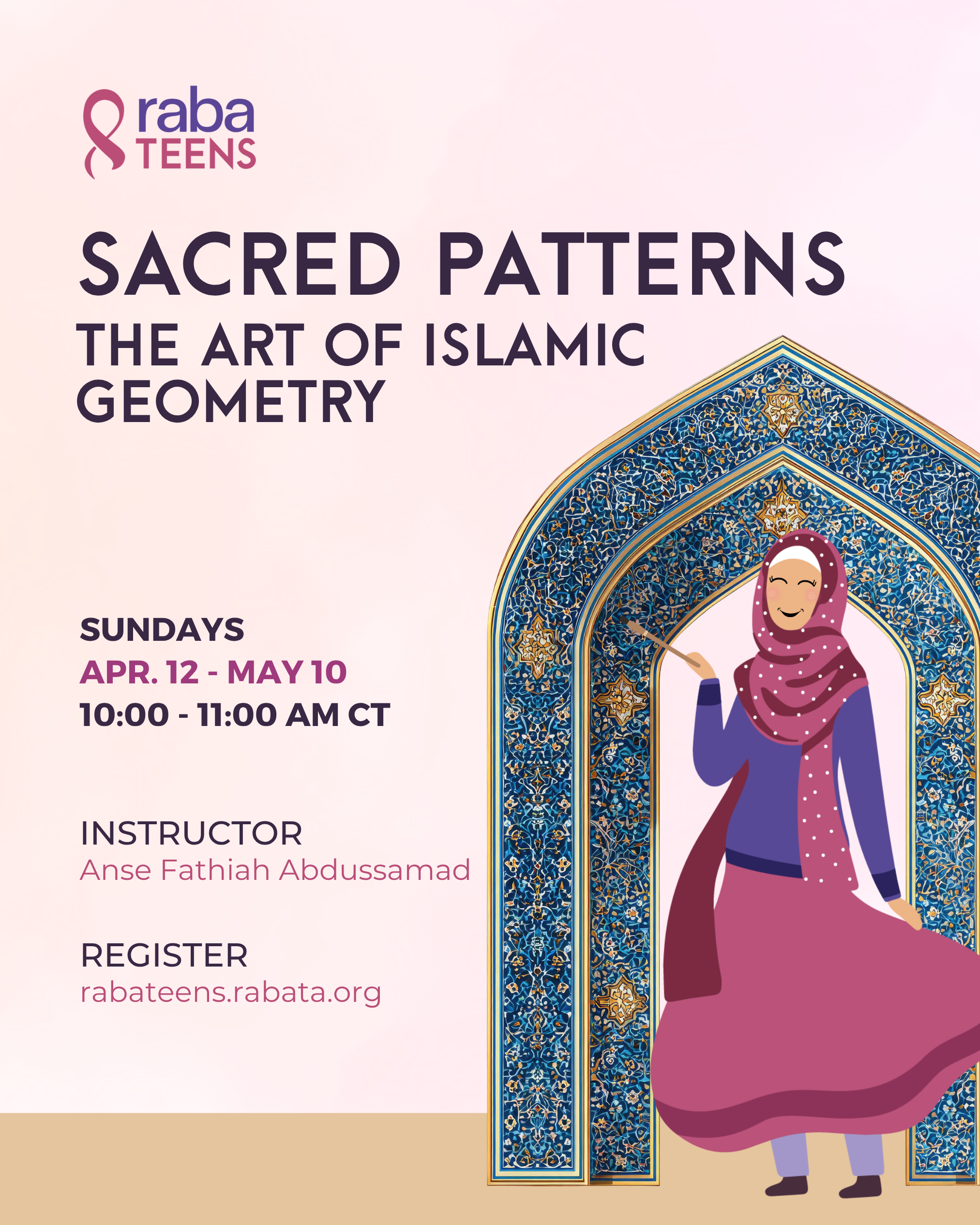
Sacred Patterns: The Art of Islamic Geometry
Spring 2026
RabaTEENS is a nurturing space for deep and meaningful Islamic spiritual mentorship with compassionate and caring mentors. We design fun, creative, and positive educational experiences to help teens grow confidently and comfortably into their faith.
Islamic art has long been a beautiful form of learning and spiritual expression, connecting creativity, culture, and devotion. Inspired by the patterns found in mosques around the world, this class invites students to explore how art can cultivate mindfulness, reflection, and a deeper appreciation for beauty in Islam.
Over five weeks, students will learn the foundations of Islamic geometric patterns through guided, hands-on drawing activities. They will explore how simple shapes can come together to create intricate and meaningful designs, while building focus, patience, and confidence in their creative process.
This class introduces students to the idea that Allah ﷻ is beautiful and loves beauty, and that creating art can be a form of reflection and appreciation. Through pattern-making, weaving, and colouring, students will not only develop artistic skills but also gain a deeper understanding of the discipline, harmony, and spiritual dimension of Islamic art.
Week 1: 4-Fold Patterns
Students will be introduced to the basics of Islamic geometric design by creating 4-fold patterns. Through guided drawing, they will learn how simple lines and shapes can form balanced and symmetrical designs, building a strong foundation for future patterns.
Week 2: 6-Fold Patterns
In this session, students will explore 6-fold patterns and how geometry can expand into more intricate designs. They will continue developing their drawing skills while learning about symmetry, repetition, and precision in Islamic art.
Week 3: 8-Fold Patterns
Students will work with 8-fold patterns, creating more complex and detailed designs. This session emphasizes patience, focus, and careful construction, while allowing space for creativity in pattern development.
Week 4: Weaving Patterns
This week introduces weaving techniques within geometric designs, helping students see how patterns can interconnect and flow. Students will experiment with layering, colouring, and visual depth to bring their designs to life.
Week 5: Tessellation of Patterns
In this final session, students will explore tessellation and how patterns repeat seamlessly across a surface. They will bring together everything they have learned to create a complete piece, reflecting on the beauty, structure, and meaning behind Islamic geometric art.
Pencil
Pen
Ruler
A4 or A3 notebooks for practice
(recommended: thick paper notebook, at least 150 gsm)
Compass
None
Sundays, 10:00 - 11:00 AM Central Time
Session dates: April 12 - May 10
Students must attend Zoom live sessions. Classes are NOT recorded.
*Enrollment into the RabaTEENS program is on a per-student basis. If two (or more) students are planning to attend a class together by sharing a screen, each student will need to enroll for class individually.
**RabaTEENS programs are for girls aged 12-17 ONLY. Students are required to be 12 already in order to join any of RabaTEENS programs.
Certificates of participation are available upon request.
No refunds are issued once the session begins.
Meets once a week for one hour (5-week session)
Regular price
