
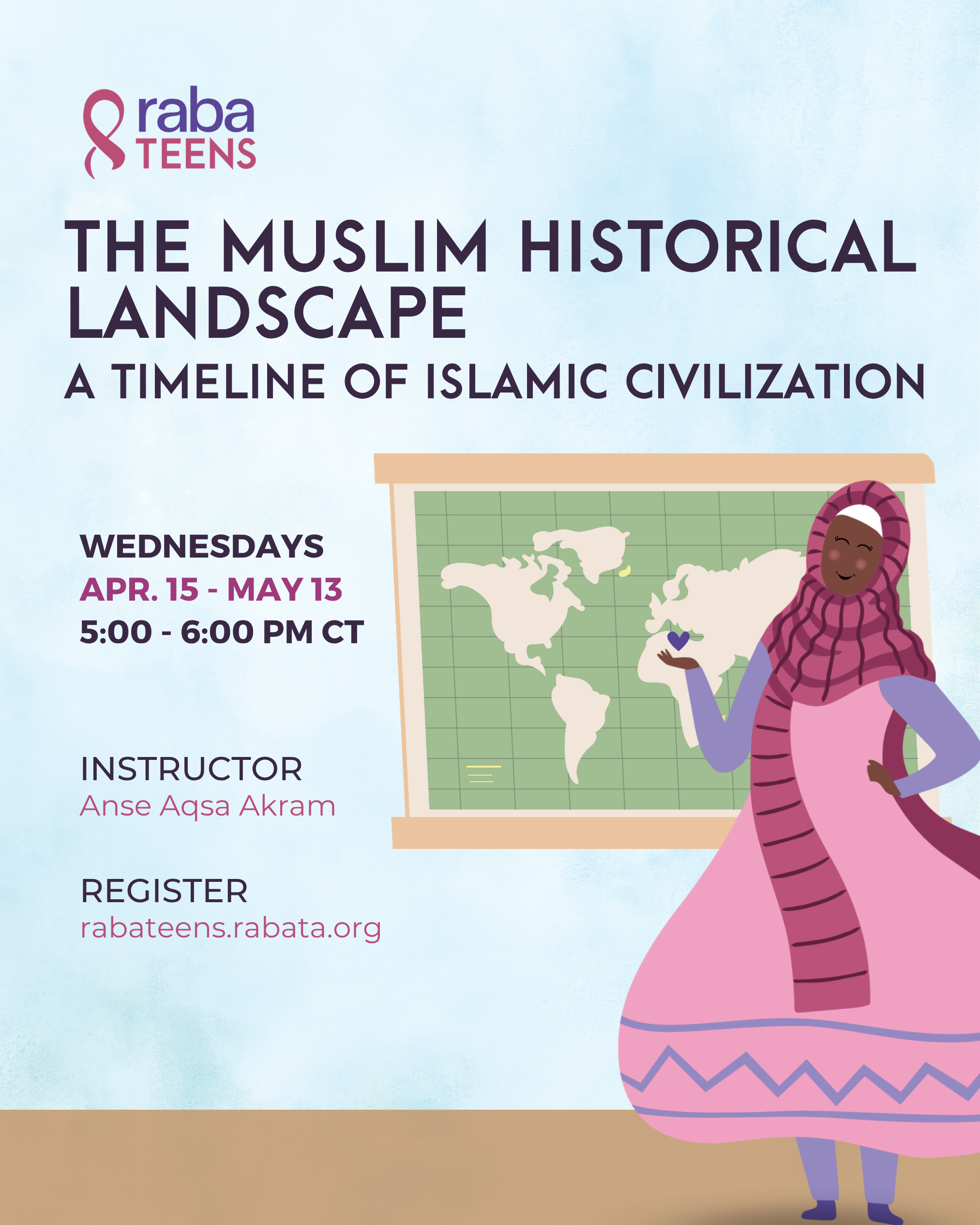
The Muslim Historical Landscape: A Timeline of Islamic Civilization
Spring 2026
RabaTEENS is a nurturing space for deep and meaningful Islamic spiritual mentorship with compassionate and caring mentors. We design fun, creative, and positive educational experiences to help teens grow confidently and comfortably into their faith.
Join us in this inspiring history class designed for teen girls, where we will explore the rich heritage of Islam and gain the confidence to navigate the future by learning from the past.
The history of the Muslim world has been shaped by the rise and fall of several powerful and influential caliphates that expanded across vast regions, impacting culture, politics, economics, and religion. In this inspiring history class, we will explore the struggles, triumphs, and achievements of the Muslim Ummah across history and discover how learning about these shared experiences fosters a sense of community and responsibility toward our fellow Muslims.
We will journey across the lands and peoples that Islam has reached, and across past Muslim time periods, from the Rightly Guided Caliphs, the Umayyads and Abbassids to the Mughal and Ottoman periods. Along the way, we will highlight key moments, achievements, and lessons that have shaped our history and offer inspiration for understanding who we are as an ummah and making a meaningful impact in our lives and beyond.
Week 1: The Birth of Islam and the Early Caliphate
In this first session, we will explore the birth of Islam and the early caliphates, starting with the life of Prophet Muhammad ﷺ and the key tenets of Islam. We will examine the rise of the Islamic state, including the migration (Hijrah) to Medina and the establishment of the first Muslim community, followed by the leadership of the Rashidun Caliphate, its expansion, and key events such as the Battle of Yarmouk and the first civil war (Fitna). The session will conclude with a discussion on the legacy of the Rashidun Caliphate and its influence on Islamic governance and theology.
Week 2: The Umayyad and Abbasid Caliphates
In Session 2, we will delve into the expansion and cultural development of the Umayyad and Abbasid caliphates. We will explore the Umayyad dynasty’s vast empire, from al-Andalus (Spain) to India, and its political reforms, followed by the rise of the Abbasid Caliphate, which ushered in a Golden Age of scientific, philosophical, and literary advancements. The session will also cover the decline of the Abbasids, the fragmentation of the empire, and the Mongol invasions, concluding with a discussion on the lasting cultural legacy of the Abbasids.
Week 3: The Ottoman Period: Rise and Golden Age
In Session 3, we will explore the rise and Golden Age of the Ottoman period, beginning with its origins in Anatolia and the conquest of Constantinople under Sultan Mehmed II. We will examine the reign of Suleiman the Magnificent, highlighting the empire’s political, military, and cultural achievements, and its role as a center of Islamic power. The session will also cover the causes of the empire’s decline, including internal issues, military defeats, and European expansion, followed by a discussion on the Ottoman period’s lasting significance in world history.
Week 4: The Mughal Period
In Session 4, we will explore the rise and influence of the Mughal period in South Asia, beginning with its foundation by Sultan Babur and the height of Islamic rule under Emperor Aurangzeb. We will examine Mughal contributions to art, architecture (such as the Taj Mahal), culture, and the spread of Islam, as well as their role in governance, agriculture, and the economy. The session will also cover the period’s decline due to weak leadership, succession disputes, and the rise of British influence, followed by a discussion on the Mughal period’s lasting impact on world history.
Week 5: Safavid Period and the Modern Islamic World
In this final session, we will explore the impact of the Safavid period, including its cultural contributions such as advancements in art and architecture. We will then examine the influence of European colonialism on the Muslim world, the rise of modern Islamic states, and the challenges they face in balancing modernization, secularism, and Islamic governance. The session will conclude with a reflection on the enduring legacy of Islamic civilization, from its contributions to science and philosophy to its continued influence on the contemporary world.
Pen and paper for note-taking
None
Wednesdays, 5:00 - 6:00 PM Central Time
Session dates: April 15 - May 13
Students must attend Zoom live sessions. Classes are NOT recorded.
*Enrollment into the RabaTEENS program is on a per-student basis. If two (or more) students are planning to attend a class together by sharing a screen, each student will need to enroll for class individually.
**RabaTEENS programs are for girls aged 12-17 ONLY. Students are required to be 12 already in order to join any of RabaTEENS programs.
Certificates of participation are available upon request.
No refunds are issued once the session begins.
Meets once a week for one hour (5-week session)
Regular price
